
Protein-Protein interactions
Protein-Protein interactions (PPIs) refers to the formation of physical contacts between proteins to perform biochemical functions. Both non-covalent interactions and covalent interactions contributes to PPIs. Generally, covalent PPIs involves strong association such as disulfide bonds.
Non-covalent PPIs are formed by hydrogen bonds, salt bridge, and Van der Waals interactions.
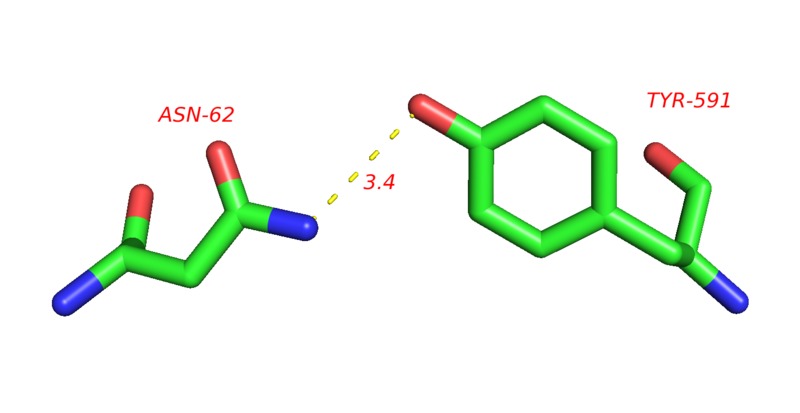
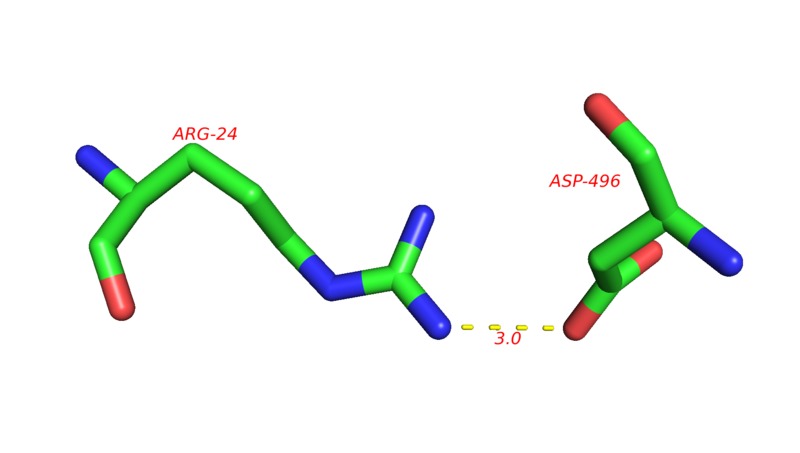
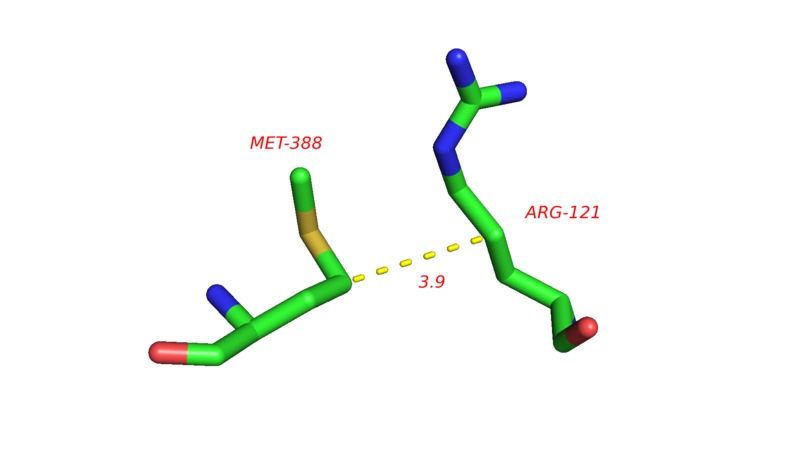
*In these diagrams, carbon, oxygen, nitrogen and sulfur are colored accordingly.
Hydrogen bonds
Hydrogen bond is formed between H atom and other electronegative atoms, such as N, O and S. The basic composition of hydrogen bonds is X-H…Y, where H and Y atom (having a lone pair of electrons) are called the proton donor and proton acceptor respectively.
A single hydrogen bond usually contributes an energy of 0.5-1.8 kcal/mol to the interaction.1
Salt bridge
Salt bridge (ionic bond) is less common in PPIs. The opposite charged amino acid side chains within 4Å can attract each other and form an ionic bond.2 The salt bridge usually forms between (RCOO-) of aspartate or glutamate and (RNH3+) of lysine or a guanidine of arginine.
The ΔG value of salt bridge is around 2-4 kcal/mol.3
Van der Waals interactions
Van der Waals interactions are caused by attractive force between slight permanent dipoles. They are weak interactions individually, ranging from 0.5-1 kcal/mol,4 but are strong when they accumulate in vast numbers.
References
1. Pace CN, Fu H, Fryar KL, et al. Contribution of hydrogen bonds to protein stability. Protein Sci. 2014;23(5):652-661. doi:10.1002/pro.2449
2. Kumar S, Nussinov R. Close‐Range Electrostatic Interactions in Proteins. ChemBioChem. 2002;3(7):604-617. doi:10.1002/1439-7633(20020703)3:7<604::AID-CBIC604>3.0.CO;2-X
3. Eun H-M. Enzymology Primer for Recombinant DNA Technology. Academic Press; 1996.
4. Foye, W.O. & Lemke, T.L., 2008. Foye's principles of medicinal chemistry Sixth., Philadelphia: Lippincott Williams & Wilkins.