
Binding Affinity

Binding affinity (natural inclination for molecular association) is the strength of the reversible binding interaction between two or more molecules (General biomolecular interaction present as formula 1).
It is translated into physico-chemical terms as the Dissociation constant (Kd) (formula 2), which determines the strength of an interaction at equilibrium.
Smaller the Kd value, greater is the binding affinity.

Binding affinity can also be defined in thermodynamic terms as Standard Gibbs free energy (ΔG˚’) (formula 3); where R is ideal gas constant and T is temperature in Kelvin. ΔG˚’ should be positive to favour an interaction.1
Once we know the standard-state free energy change of an interaction at a given temperature, it makes us possible to calculate binding affinity with the relationship between ΔG˚’ and Kd.
? Why do we focus on the contribution of non-covalent bonds to binding affinity within interfaces ?
Binding affinity is greatly influenced by non-covalent intermolecular interactions, which govern a majority of the biological processes as they help stabilise protein interactions. Non-covalent bonds between protein-protein interface determine the strength of the interaction. Perturbations in these interactions may cause changes in affinity and thereby lead to various diseases.2
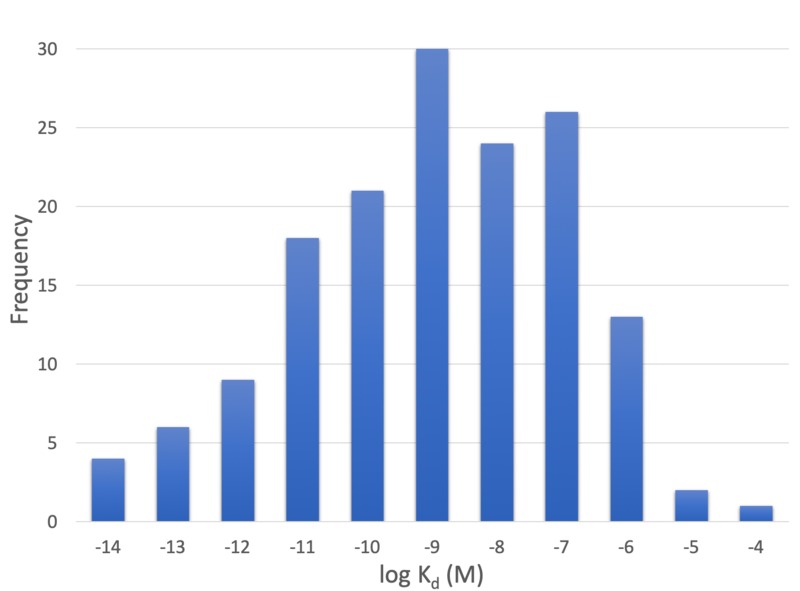
General Kd frequency
The histogram shows the frequency distribution of 154 log Kd values representing different protein-protein affinity. The data was collected from Protein-protein interaction database 2.0 which is based on practical experiments. As shown in the histogram, the average range of log Kd of PPI is from 10-12 M to 10-6 M, which indicates adramatically higher affinity than that of protein-ligand interaction (10-10 M ≤ logKd ≤ 10-4 M).3
References
1. Kastritis PL, Bonvin AMJJ. On the binding affinity of macromolecular interactions: Daring to ask why proteins interact. J R Soc Interface. 2013;10(79). doi:10.1098/rsif.2012.0835
2. Vangone A, Bonvin AMJJ. Contacts-based prediction of binding affinity in protein–protein complexes. Elife. 2015;4(JULY2015). doi:10.7554/eLife.07454
3. Caro JA, Harpole KW, Kasinath V, et al. Entropy in molecular recognition by proteins. Proc Natl Acad Sci U S A. 2017;114(25):6563-6568. doi:10.1073/pnas.1621154114