
Non-covalent bond contributions
The contributions of hydrogen bond (H-bond), salt bridge and Van der Waals interaction to protein-protein binding affinity are analysed through comparing Kd of CTF3, MCM21, CTF19 interfaces. As the mathematic model to predict Kd is based on experimental ∆G˚' data ranging from -6 to -14 kcal/mol, the corresponding Kd in this range gives contributions of non-covalent bonds/interactions qualitatively.
Hydrogen bonds
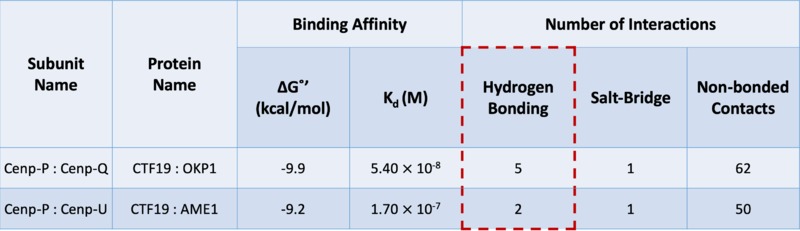
H-bonds are essential for PPIs binding, contributing to protein energetics. The average number of H-bonds between an interface is 12 and several H-bonds alterations may cause significant binding affinity changes.
▻ In this example, three H-bonds alteration leads to over two-fold changes in Kd and 0.7 kcal/mol change in binding energy (under conditions of similar number of salt bridge and Van der Waals interactions).
Salt bridge
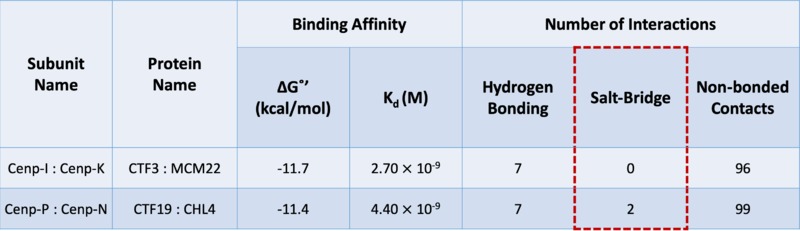
Although the strength of salt bridge ranges from 2-4 kcal/mol, some studies suggest it contributes little to binding affinity.
▻ Two salt bridge alteration leads to a 1.6-fold change in Kd and 0.3 kcal/mol change in binding energy (under conditions of similar number of H-bonds and Van der Waals interactions) and most PPIs only have one or two salt bridges.
▻ Study of Erijman et.al also shows a similar conclusion1.
Van der Waals interactions
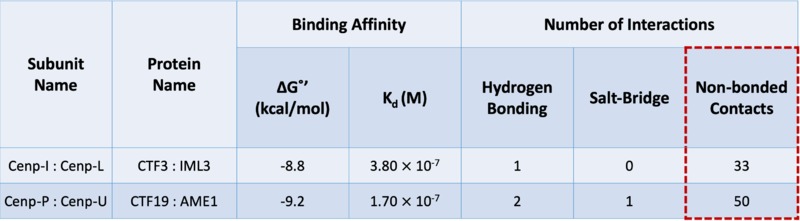
Single Van der Waals interaction contributes little to binding affinity. However, large number of VDW interactions, due to extensive interfaces between proteins, contributes to binding affinity.
▻ 17 VDW interaction alterations leads to over one-fold change in Kd and 0.4 kcal/mol change in binding energy (under similar conditions of number of H-bonds and salt bridge).
▻ As number of VDW interactions is correlated to buried surface area, it may contribute more in larger interfaces.
⭐Special case of salt bridge
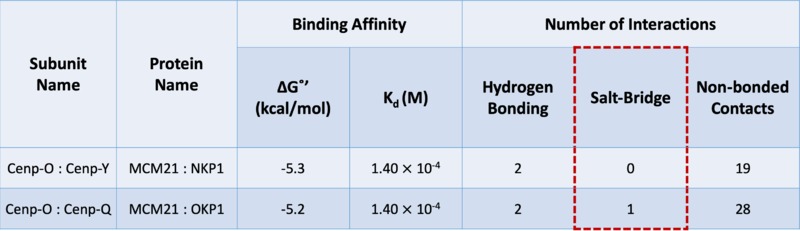
In this case, the increasing one salt bridge decrease binding energy by 0.1 kcal/mol (under conditions of similar H-bond and a difference of 9 VDW interactions). The salt bridge counteraction of binding affinity in this special case is wired but explainable.
▻ First, salt bridge alters interface conformation and solvent distribution to make the interaction more entropically unfavourable.
▻ Second, 5.2 kcal/mol is a relatively low energy that may not be that accurate while using this model to predict.
Reference
1. Erijman A, Rosenthal E, Shifman JM. How Structure Defines Affinity in Protein-Protein Interactions. Kobe B, ed. PLoS One. 2014;9(10):e110085. doi:10.1371/journal.pone.0110085