
Helical pattern CTF3 interface
An overview of CTF3 interface conservation.
👉Please zoom out your screen to 80% (Browser Option: Zoom out-80%)

Scale bars of conservation and hydrophobicity

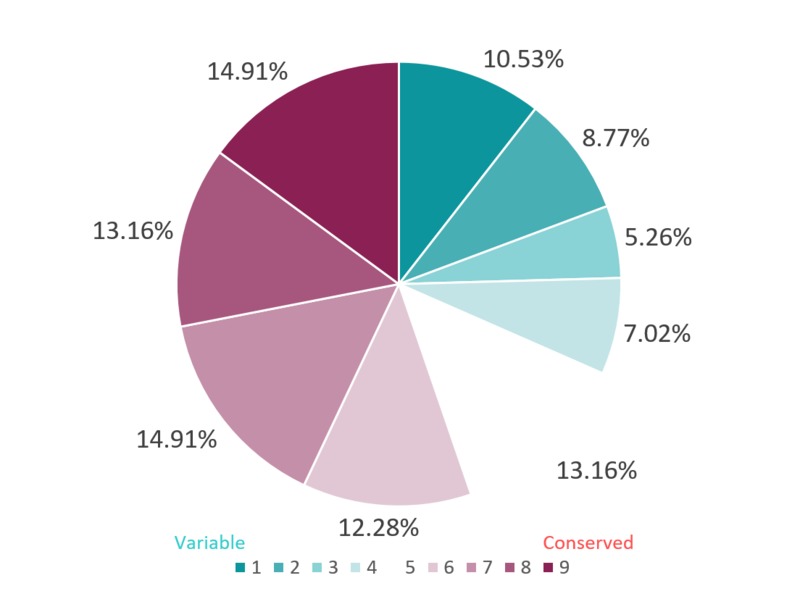
Overall, the CTF3 interface shows an interesting helical form surrounding its surface. The highly conserved area is consistent with hydrophobic areas, driving strong binding between subunits.
CTF3:MCM16 interface is like a 'L' shape or more likely a hoop-shape. It is larger than the rest of the three interfaces and is predicted to be essential for binding. Highly conserved residues gather at the top-half CTF3 interface. The highly hydrophobic interface is also essential for binding.
The CTF3:MCM22 interface appears to be linear and is adjacent to the CTF3:MCM16 interface. Highly conserved residues form a pocket at the centre of this interface. Hydrophobic residues gather at the centre of interface.
CTF3:IML3 forms a flat interface at the bottom of CTF3 with limited hydrophobic residues at the rim.
The CTF3:CTF19 interface is the smallest amongst the four interfaces and contains only 12 residues. But the hydrophobic residues at the interface centre could contribute to the binding to form such a small interface.