
Highly conserved binding Site
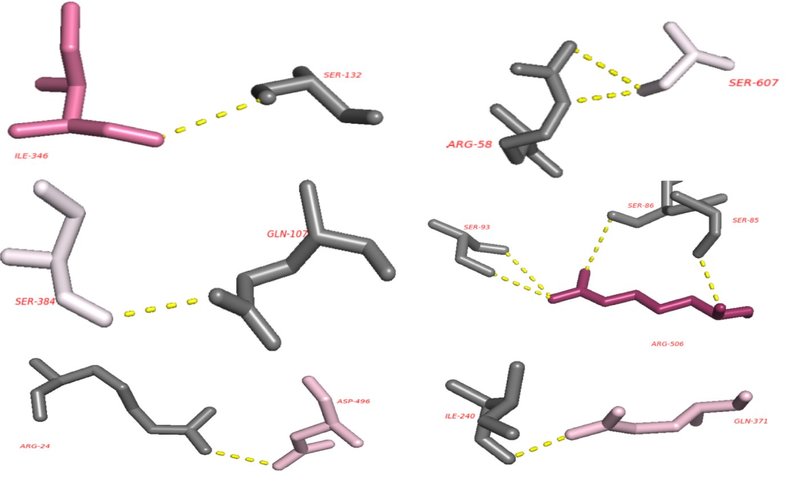
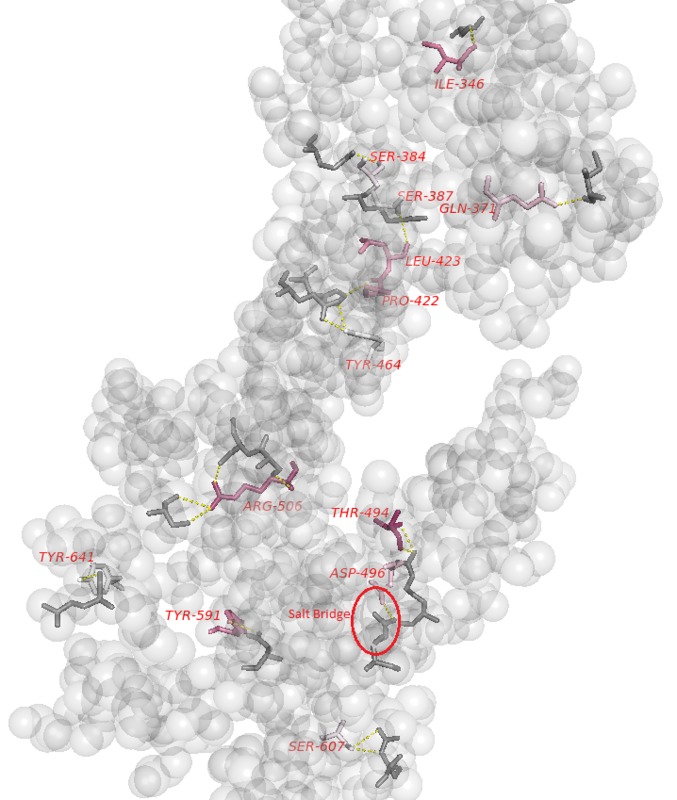
In total, 19 hydrogen bonds and 1 salt bridge is formed in the binding site between CTF3 and its partner protein complex. Several residues listed below are highly conserved which may indicate their essential function in configuration maintaining and protein-protein interactions. It is essential to notice that no H-bond or salt bridge is formed in the interface between CTF3 and CTF19.
ARG506: Hydrophilic residue forming hydrogen bond with three serine residues in MCM22 and MCM16
ILE346: Hydrophobic residue forming hydrogen bond with serine residue in MCM16
TYR591: Hydrophobic residue forming hydrogen bond with asparagine residue in MCM16
ASP496: Hydrophilic residue forming salt bridge with arginine residue in MCM16
THR494: Neutral residue forming hydrogen bond with arginine residue in MCM16
PRO422: Neutral residue forming hydrogen bond with histidine residue in MCM16
LEU423: Hydrophobic residue forming hydrogen bond with arginine residue in MCM16
The salt-bridge and most of the hydrogen bonds linked with highly conserved CTF3 residues are formed in the interface between CTF3 and MCM16, indicating that the protein interaction between these two subunits may be essential in molecule function and protein stability.
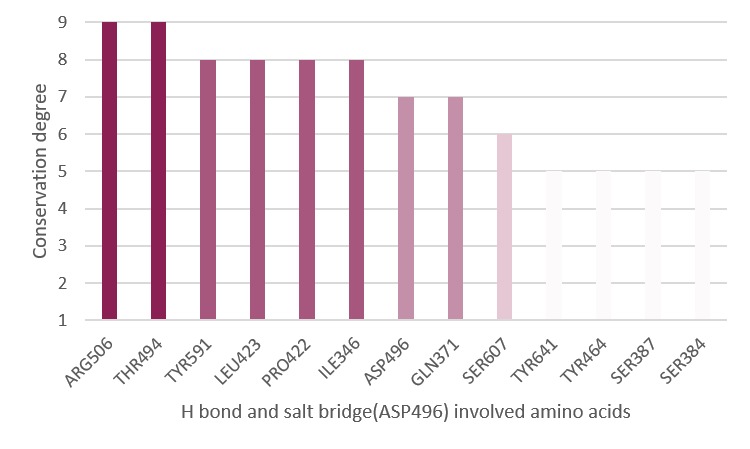
Conservation degree of H bond and salt bridge(ASP496) involved amino acids

Thank you for visiting our exhibit!
Please view our second virtual museum 👉Non-covalent Bonding & Interface Binding Affinity