
The CCAN complex
The eukaryotic inner kinetochore CCAN complex (known as CTF19 in S. cerevisiae) is a hetero 22-mer, assembled onto a specialized Cenp-A nucleosomes (histone variant Cenp-A replaces the canonical histone H3) and is composed of 19 distinct polypeptide molecules and two distinct DNA molecules. 1,2,3 By directly binding to the centromeric nucleosome the CCAN kinetochore network plays a critical role in controlling kinetochore-microtubule dynamics and outer kinetochore assembly. 4
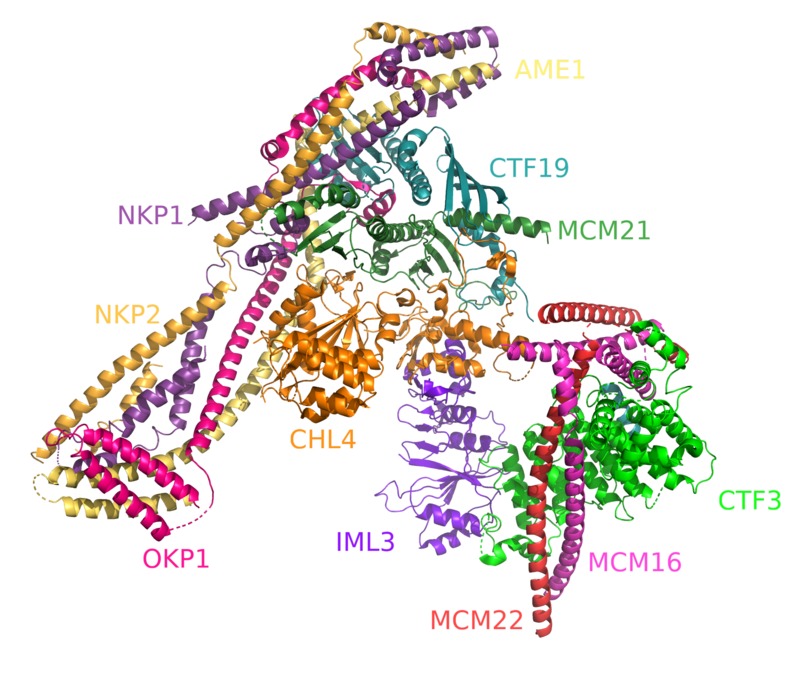
The CCAN subunit CTF3 (Chromosome transmission fidelity protein 3] mostly consists of HEAT repeats (EF3- Huntingin elongation factor 3, PP2A- protein phosphatase 2A, and yeast kinase TOR1 repeats).5 The conserved CTF3 complex is responsible for stable microtubule binding and is essential for the recruitment of the cohesin loading complex - Scc2/4.6
🔬 CTF3 had been initially identified as a kinetochore protein by a genetic synthetic dosage lethality screen and its interaction with the centromeric DNA had been confirmed via chromatin immunoprecipitation. A genome-wide two-hybrid screen was further employed to study the activity of CTF3.7
References
1. Schleiffer, A. et al. CENP-T proteins are conserved centromere receptors of the Ndc80 complex. Nat. Cell Biol. 14, 604–613 (2012).
2. Cheeseman, I. M. et al. Phospho-regulation of kinetochore-microtubule attachments by the Aurora kinase Ipl1p. Cell 111, 163–172 (2002).
3. PDB 6qld structure summary ‹ Protein Data Bank in Europe (PDBe) ‹ EMBL-EBI. Available at: https://www.ebi.ac.uk/pdbe/entry/pdb/6QLD. (Accessed: 3rd February 2020)
4. McAinsh, A. D. & Meraldi, P. The CCAN complex: Linking centromere specification to control of kinetochore–microtubule dynamics. Semin. Cell Dev. Biol. 22, 946–952 (2011).
5. Basilico, F. et al. The pseudo GTPase CENP-M drives human kinetochore assembly. Elife 2014, (2014).
6. Hinshaw, S. M., Dates, A. N. & Harrison, S. C. The structure of the yeast Ctf3 complex. Elife 8, (2019).
7. Measday, V. et al. Ctf3p, the Mis6 budding yeast homolog, interacts with Mcm22p and Mcm16p at the yeast outer kinetochore. Genes Dev. 16, 101–113 (2002).