How well conserved are residues at CHL4 interfaces?
Interfaces governed by hydrophobic residues are poorly conserved
The residues of small interfaces on CHL4 are poorly conserved and mainly hydrophobic.
Their sole involvement in non-contact bonds likely justifies their low conservation.
The CHL4:MCM21 interface
In the extended CHL4/MCM21 interface, the majority of well conserved residues is located in a central distinct patch.
Three separate conserved residues are in a distal "arm" of the interface, which can still be regarded to be part of the central patch.
The majority of poorly conserved residues is located in the periphery of the interface.
The CHL4:CTF19 interface allows optimal interactions between CHL4 and MCM21
This CHL4 interface forms a projection that fits into a cap-like feature of CTF19. Two distinct regions of conserved residues are observed.
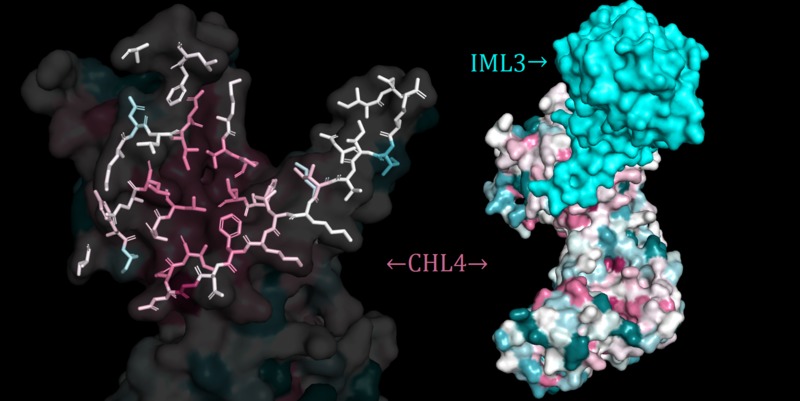
The CHL4-IML3 interface forms a characteristic shape
CHL4 forms a large U-shaped groove that accommodates IML3.
The majority of conserved residues in the interface are located centrally within the groove, right where IML3 makes the most contacts.
The residues are both polar and non-polar in nature. This may allow for the establishment of strong interactions.